
Key Takeaways:
- Machine learning consulting services fall into three delivery models: independent consultants, consulting agencies, and in-house teams — each with distinct cost, risk, and speed tradeoffs.
- Independent ML consultants cost $100-$250/hour and are best for focused, well-scoped projects under 3 months.
- ML consulting agencies cost $15,000-$150,000 per engagement and deliver cross-functional teams for complex, multi-month initiatives.
- In-house ML teams cost $300K-$800K+ annually in salaries alone and make sense only when ML is a core, ongoing business function.
- A hybrid model — agency for build, consultant for optimization, in-house for maintenance — often delivers the best ROI for growing companies.
Machine Learning Consulting Services: Consultant vs Agency vs In-House — Which Should You Choose in 2026?
Machine learning is no longer a research experiment — it's a production capability that 72% of enterprises now deploy in at least one business function, according to McKinsey's 2024 The State of AI report. But building ML systems that actually generate ROI requires specialized talent that most companies don't have on staff. That's where machine learning consulting services come in.
The question isn't whether you need ML expertise — it's how you source it. Do you hire an independent consultant for a focused project? Engage a consulting agency with a full team? Or build an in-house ML capability? Each path carries different costs, timelines, risks, and outcomes. This guide breaks down all three options with real pricing data, decision frameworks, and a practical comparison so you can choose with confidence.
What Are Machine Learning Consulting Services?
Machine learning consulting services encompass the professional expertise required to design, build, deploy, and maintain ML models and systems for business applications. These services typically include:
- Use case discovery and feasibility analysis — identifying where ML creates the most value in your business
- Data strategy and pipeline engineering — ensuring you have clean, accessible, properly structured training data
- Model development and training — selecting algorithms, training models, and tuning for production performance
- MLOps and deployment — building the infrastructure to serve models at scale with monitoring and retraining
- Model monitoring and optimization — tracking drift, accuracy decay, and business impact over time
According to Gartner's 2024 Hype Cycle for AI, the gap between ML proof-of-concept and production deployment remains the single biggest barrier to ML ROI. Consulting services exist to close that gap — turning model experiments into reliable, monitored, business-driving systems.
The Three Delivery Models: A Side-by-Side Comparison
Before diving into each option, here's a high-level comparison of what you get from each approach:
| Dimension | Independent ML Consultant | ML Consulting Agency | In-House ML Team |
|---|---|---|---|
| Cost Range | $100-$250/hour $5K-$25K/project | $15K-$150K/engagement | $300K-$800K+/year (salaries) |
| Team Size | 1 person | 3-8 specialists | 2-10+ FTEs |
| Time to Start | 1-2 weeks | 2-4 weeks | 3-6 months (hiring) |
| Expertise Breadth | Deep but narrow | Broad + deep (cross-functional) | Depends on hires |
| Best For | Focused, scoped projects | Complex, multi-system builds | Ongoing core ML function |
| Risk Level | Medium (key-person dependency) | Low (team redundancy) | High (hiring, retention) |
| Flexibility | High | Medium | Low (fixed headcount) |
1. Independent Machine Learning Consultants
Independent ML consultants are individual experts — typically PhD-level data scientists or senior ML engineers — who work directly with your team on a contract basis. They're the surgical option: precise, focused, and cost-effective for well-defined problems.
When to choose an independent consultant:
- You have a clearly scoped problem (e.g., "build a churn prediction model from our CRM data")
- Your project is under 3 months in duration
- Your internal team has engineering capability but lacks ML-specific expertise
- You need a specific skill (e.g., NLP, computer vision, time-series forecasting) that's hard to hire for
Pricing breakdown:
- Hourly: $100-$250/hour depending on specialization and geography
- Project-based: $5,000-$25,000 for a scoped model build
- Retainer: $3,000-$8,000/month for ongoing optimization
Real example: A B2B SaaS company engaged an independent ML consultant to build a lead-scoring model. The consultant delivered a production-ready model in 6 weeks for $18,000, integrating it with the company's existing CRM pipeline. The model improved sales conversion rates by 23% within the first quarter.
Limitations: An individual consultant is a single point of failure. If they're unavailable, your project stalls. They also rarely have the full-stack MLOps expertise needed to build production infrastructure — they build models, not necessarily the systems that serve them.
2. Machine Learning Consulting Agencies
ML consulting agencies bring cross-functional teams — data engineers, ML scientists, MLOps engineers, and project managers — to deliver end-to-end ML systems. They're the comprehensive option: more expensive but lower-risk and capable of handling complex, multi-system initiatives.
When to choose a consulting agency:
- Your project spans multiple systems (data pipeline + model + deployment + monitoring)
- You need production-grade MLOps, not just a model notebook
- Your timeline is 3-9 months
- You want knowledge transfer so your team can maintain the system afterward
- You need compliance, security, or governance frameworks built in
Pricing breakdown:
- Discovery phase: $5,000-$15,000 (1-2 weeks)
- Full project: $15,000-$150,000 depending on scope
- Monthly retainer for ongoing support: $8,000-$20,000/month
- Typical engagement structure: 40% upfront, 30% milestone, 30% on delivery
Real example: A logistics company partnered with an ML consulting agency to build a demand forecasting system. The agency deployed a 5-person team (1 project manager, 2 data engineers, 1 ML scientist, 1 MLOps engineer) over 4 months at $85,000. The system reduced inventory carrying costs by 18% and improved forecast accuracy from 71% to 89%.
Limitations: Agencies cost more than individual consultants. They also require more onboarding time — your team needs to provide data access, infrastructure context, and business requirements. And not all agencies are equal: some are software shops that recently added "ML" to their marketing. Always verify their actual ML project portfolio.
3. In-House Machine Learning Teams
Building an in-house ML team means hiring full-time data scientists, ML engineers, and MLOps specialists as permanent employees. This is the highest-investment, highest-commitment option — but it gives you maximum control and long-term capability.
When to build an in-house team:
- ML is a core, ongoing business function (not a one-time project)
- You have multiple ML use cases planned over 12+ months
- You need deep domain expertise that's specific to your industry
- Your data is too sensitive to share with external parties
- You have budget for $300K-$800K+ in annual salaries plus infrastructure
Cost breakdown (annual):
- Junior Data Scientist: $90K-$130K
- Senior Data Scientist: $130K-$200K
- ML Engineer: $120K-$180K
- MLOps Engineer: $130K-$190K
- ML Team Lead / Manager: $160K-$220K
- Plus 20-30% for benefits, taxes, and infrastructure
A minimal viable team (1 ML engineer + 1 data scientist + 1 MLOps engineer) costs roughly $350K-$540K/year in salaries alone. A full team of 5-7 specialists runs $600K-$1.2M annually.
Limitations: Hiring ML talent is notoriously difficult — the average time-to-fill for a senior data scientist role is 76 days, according to a 2024 Deloitte AI workforce report. Retention is equally challenging: ML professionals change jobs every 2-3 years on average. And an under-staffed or under-skilled in-house team can be worse than no team at all — they produce models that never reach production.
The Hybrid Model: Getting the Best of All Three
Smart companies don't choose one model — they blend them. A common, proven pattern:
- Phase 1 (Months 1-4): Engage an agency to build the initial ML system end-to-end. They handle data engineering, model development, and MLOps infrastructure. Budget: $40K-$90K.
- Phase 2 (Months 4-6): Bring in a consultant to optimize the model, fine-tune for your specific data patterns, and train your internal engineers on maintenance. Budget: $10K-$20K.
- Phase 3 (Month 6+): Transition to in-house with 1-2 hires who maintain and extend the system, using the agency's codebase and the consultant's documentation as their foundation.
This approach reduces upfront hiring risk, gets you to production faster, and builds internal capability organically. It's what companies like HyreFast did — engaging external expertise to build their AI-powered matching system, then bringing maintenance in-house once the system was stable.
How to Choose: A Decision Framework
Step 1: Assess Your ML Maturity
Where are you today?
- Level 0 (No ML): You have data but no ML systems - Start with an agency or consultant for a proof-of-concept
- Level 1 (Experimenting): You have notebook models but nothing in production - Consultant or agency to build production pipeline
- Level 2 (Production): You have 1-2 models in production - Consultant for optimization, consider first in-house hire
- Level 3 (Scaling): You have multiple models and need ML platform capabilities - Build in-house team, use consultant for specialized gaps
Step 2: Evaluate Project Scope and Timeline
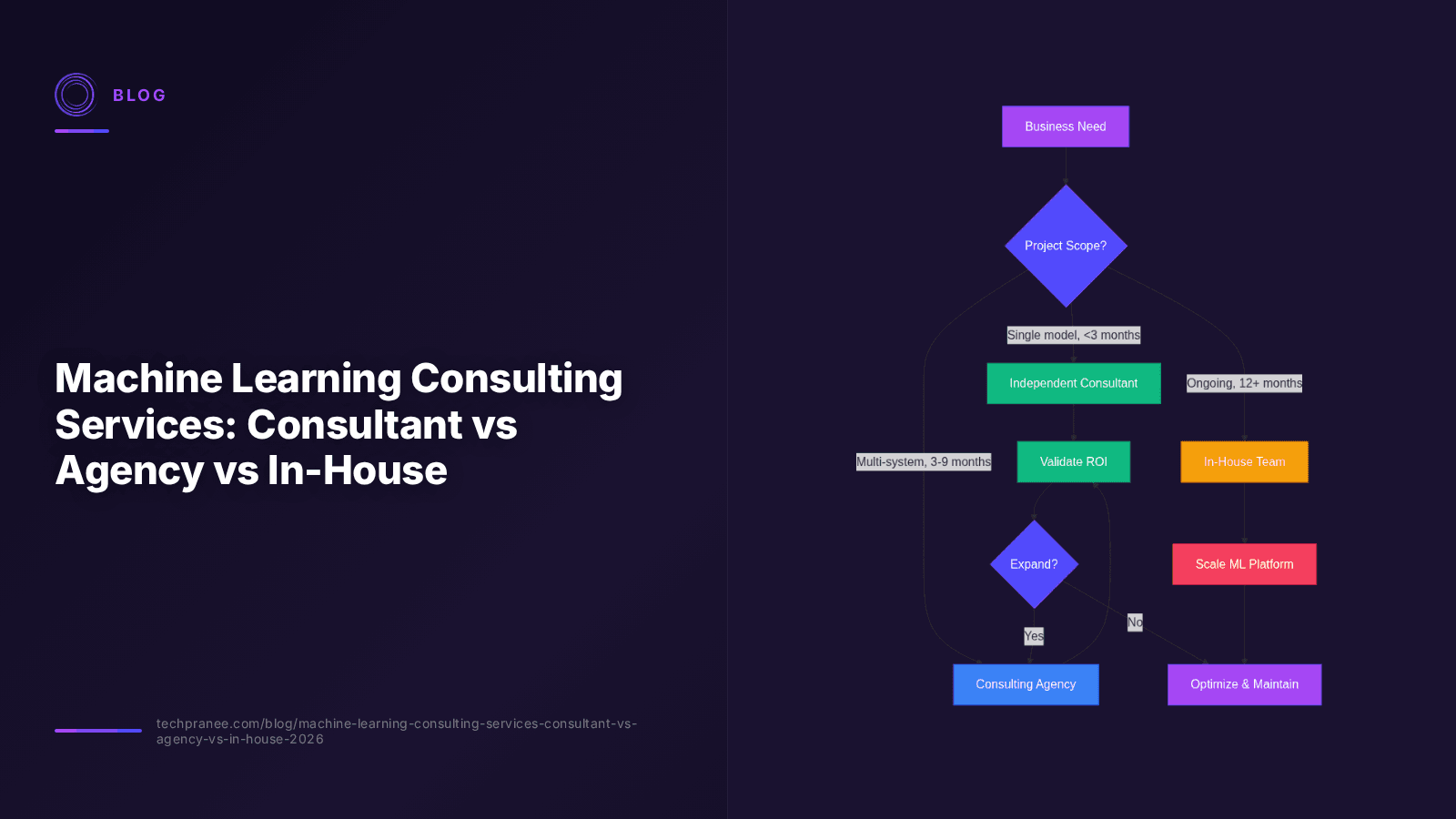
| If your project is... | Recommended approach |
|---|---|
| Single model, under 3 months, clear scope | Independent consultant |
| Multi-component system, 3-9 months | Consulting agency |
| Ongoing, 12+ months, multiple use cases | In-house team (+ agency for initial build) |
Step 3: Run a Cost-Risk Analysis
Compare total cost of ownership over 12 months:
- Consultant path: ~$30K-$60K (project + retainer), low commitment, easy to exit
- Agency path: ~$60K-$120K (project + support), medium commitment, contract-defined exit
- In-house path: ~$400K-$700K (salaries + infrastructure + hiring costs), high commitment, difficult to exit
Step 4: Check Your Data Readiness
No ML model succeeds without good data. Before engaging any external help, assess:
- ✓ Is your data centralized and accessible (not siloed across 5 tools)?
- ✓ Do you have labeled training data, or will that need to be created?
- ✓ Is your data pipeline automated, or is it manual CSV exports?
- ✓ Do you have data governance policies (privacy, retention, access)?
- ✓ Is your engineering team able to support ML infrastructure needs?
If you answered "no" to more than 2 of these, start with an agency that includes data engineering in their scope — not just model building.
Red Flags to Watch For
Regardless of which model you choose, be wary of:
- "We do AI" without ML portfolio — Many software agencies have rebranded. Ask for specific ML project case studies with measurable outcomes.
- Consultants who only build notebooks — A Jupyter notebook is not a production system. Ensure they can deploy to your infrastructure.
- Agencies that won't transfer knowledge — If they build a black box and want an ongoing dependency, that's a red flag. Insist on documentation and code ownership.
- In-house hires without ML engineering experience — A great data scientist who's never deployed a model to production will struggle without MLOps support.
The most expensive ML project is the one that never reaches production. According to a 2024 BCG report, only 54% of ML projects make it from prototype to production — and the primary failure mode isn't model accuracy, it's engineering and integration gaps. Choose a partner who can deliver the full pipeline, not just the model.
Industry-Specific Considerations
Your industry shapes which model works best:
- Healthcare: Data privacy regulations (HIPAA, GDPR) often require in-house or on-premise solutions. Consider a consultant who specializes in healthcare ML compliance. See our AI healthcare consulting page.
- Manufacturing: IoT sensor data and edge deployment favor agencies with MLOps expertise. See our guide to AI for manufacturing.
- Financial services: Model interpretability and regulatory requirements (SR 11-7, GDPR) demand specialized expertise. Engage agencies with financial ML compliance experience.
- E-commerce/Retail: Fast-moving use cases (recommendation, pricing, demand forecasting) often start with consultants and scale to in-house.
Practical Action Items
- Audit your data readiness — Can you export clean, labeled training data within 1 week? If not, fix data first.
- Define one high-impact use case — Don't boil the ocean. Pick the single ML application with the clearest ROI path.
- Set a realistic budget — $15K minimum for a consultant-led proof-of-concept, $40K+ for an agency-led production build.
- Request portfolios, not pitches — Ask any provider for 2-3 case studies with before/after metrics from real clients.
- Plan for handoff from day one — Whether consultant or agency, ensure documentation and knowledge transfer are contractually required.
Frequently Asked Questions
How much do machine learning consulting services cost?
Independent ML consultants charge $100-$250/hour or $5,000-$25,000 per project. ML consulting agencies charge $15,000-$150,000 for full engagements. In-house teams cost $300K-$800K+ annually in salaries. The right choice depends on project scope, timeline, and your internal capability.
What's the difference between an ML consultant and an ML consulting agency?
An ML consultant is an individual expert who works on focused projects — typically model development or optimization. An ML consulting agency provides a cross-functional team (data engineers, ML scientists, MLOps engineers) that can build end-to-end ML systems including data pipelines, production infrastructure, and monitoring.
Should I build an in-house ML team or hire a consultant?
Build in-house when ML is an ongoing core function with multiple use cases over 12+ months. Hire a consultant or agency for one-time projects, proof-of-concepts, or when you lack internal expertise. A hybrid approach — agency for initial build, in-house for maintenance — often delivers the best ROI.
How long does an ML consulting project take?
A focused consultant project takes 4-8 weeks. An agency-led production build takes 3-6 months. The biggest time sink is usually data preparation, not model training — budget 40-60% of project time for data engineering.
Can I start with a consultant and move to an agency later?
Yes — and it's a smart approach. Many companies start with a consultant for a proof-of-concept, validate the ROI, then engage an agency to productionize the system. Just ensure the consultant's work is documented and transferable.
What should I look for in an ML consulting provider?
Look for: (1) specific ML project case studies with measurable outcomes, (2) MLOps capability (not just model building), (3) willingness to transfer knowledge and code ownership, (4) experience in your industry's data and compliance requirements, and (5) a team-based approach with redundancy (not a single key person).
Choosing the right machine learning consulting model comes down to matching your project scope, budget, and internal capability to the right expertise. Start small, validate ROI, and scale deliberately. If you're ready to explore which approach fits your specific use case, talk to our team — we'll help you assess your data readiness and map the most cost-effective path to production ML. For deeper strategic guidance, visit our AI strategy consulting page.