
Data and AI Consultant: How to Choose the Right Partner for Your Data Transformation
Key Takeaways:
- Data and AI consultants combine data engineering, analytics, and AI expertise into a single engagement — eliminating the handoff problems that plague siloed projects.
- Most organizations need a consultant when they have data but can't extract value from it, or when AI pilots stall at the proof-of-concept stage.
- Pricing ranges from $8,000 for a data strategy assessment to $200,000+ for a full data platform build with AI integration.
- The right consultant delivers a data foundation first, then layers AI on top — not the other way around.
- Look for consultants who offer reference architectures, measurable success metrics, and a clear handoff plan for your internal team.
Executive Summary
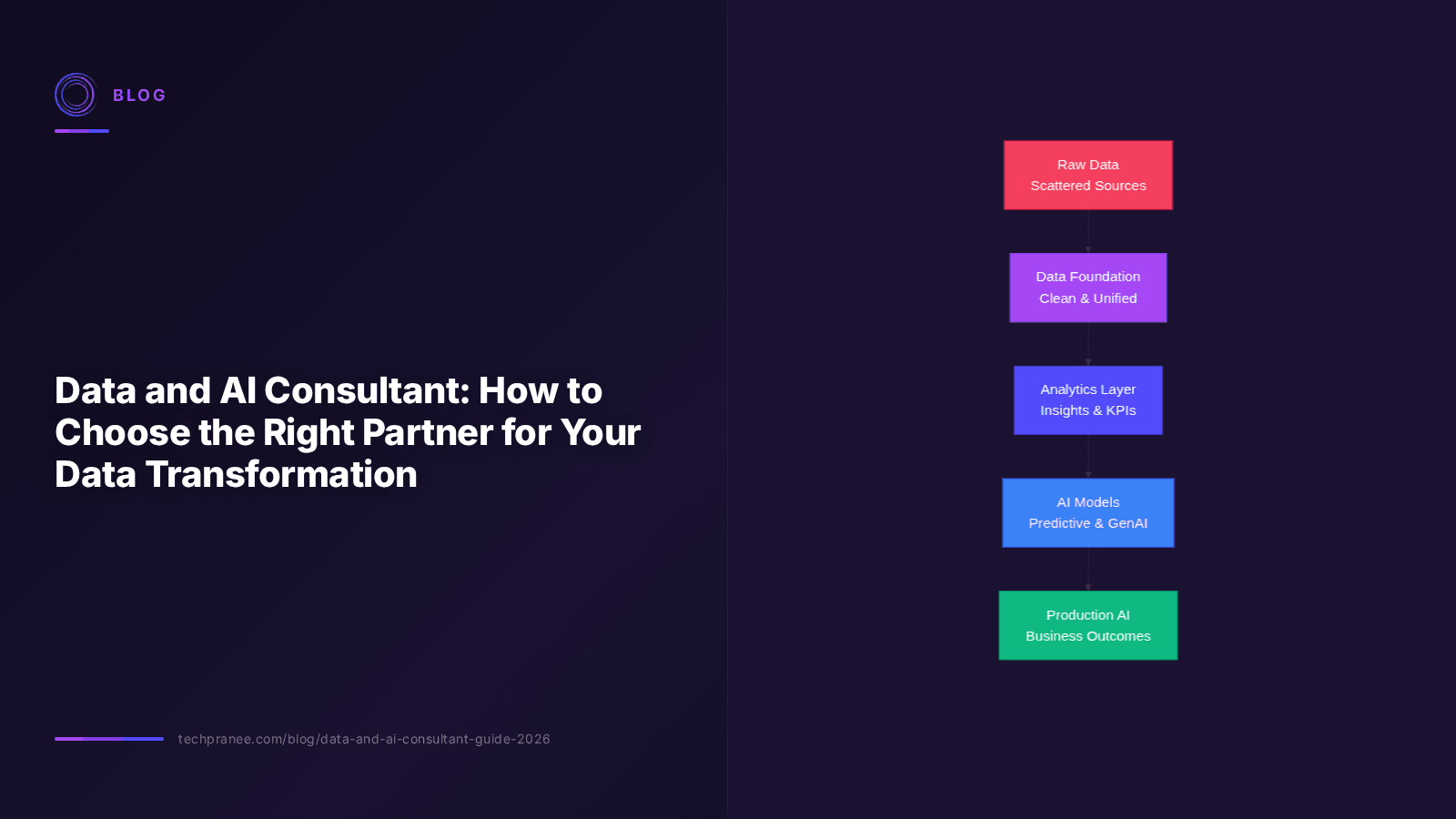
Most companies don't have an AI problem — they have a data problem. A data and AI consultant bridges that gap by combining data engineering, analytics strategy, and artificial intelligence implementation into a single, coherent engagement. Rather than hiring separate vendors for data infrastructure and AI development, organizations work with one partner who understands the full pipeline from raw data to production AI.
The market has shifted. According to a 2025 McKinsey report, 72% of companies have adopted AI in at least one business function, but only 23% have the data infrastructure to scale those initiatives beyond pilots. This gap between AI ambition and data readiness is exactly where a data and AI consultant creates value — they don't just build models, they build the foundation those models depend on.
This guide breaks down what data and AI consulting actually includes, how to evaluate whether you need it, what it costs, and how to choose the right partner for your specific transformation stage.
What Does a Data and AI Consultant Do?
A data and AI consultant provides an integrated service that covers three layers of the data-to-AI pipeline. Traditional consultants often specialize in just one layer — a data engineer builds pipelines, a data scientist builds models, an AI engineer deploys them. A data and AI consultant covers all three, ensuring each layer is designed with the others in mind.
The Three Layers of Data and AI Consulting
| Layer | What It Covers | Typical Deliverables |
|---|---|---|
| Data Foundation | Architecture, pipelines, quality, governance | Cloud data warehouse, ETL/ELT pipelines, data catalog, quality monitoring |
| Analytics & Insight | BI, reporting, dashboards, metrics | Executive dashboards, KPI frameworks, self-service analytics, anomaly detection |
| AI & ML Implementation | Predictive models, GenAI, agents, automation | ML pipelines, LLM applications, AI agents, MLOps infrastructure |
When these layers are handled by separate teams, handoff problems are inevitable. The data engineer builds a pipeline that doesn't match what the data scientist needs. The data scientist builds a model that can't be deployed by the AI engineer. A data and AI consultant eliminates these gaps by owning the full stack.
Core Service Offerings
- Data Strategy & Assessment — Audit of current data infrastructure, quality, and maturity; roadmap for transformation
- Data Architecture & Engineering — Cloud data warehouse design, pipeline construction, real-time streaming setup
- AI/ML Model Development — Predictive models for churn, demand forecasting, fraud detection, recommendation systems
- Generative AI Integration — LLM-powered applications, RAG systems, document processing, conversational AI
- AI Agent Development — Autonomous workflow agents that connect your data to business processes
- MLOps & Deployment — Model deployment, monitoring, retraining pipelines, and infrastructure for production AI
- Data Governance & Compliance — Data catalogs, access controls, lineage tracking, regulatory compliance (GDPR, HIPAA, SOC 2)
When Do You Need a Data and AI Consultant?
Not every data initiative requires external help. But specific scenarios make a consultant valuable enough to justify the cost. Here are the five most common triggers we see across industries:
5 Signs You Need a Data and AI Consultant
- Your AI pilots never reach production. If you've run multiple POCs that stalled before deployment, you likely have a data infrastructure gap that a consultant can diagnose and fix.
- Your data is scattered across 5+ systems. CRM, ERP, spreadsheets, databases, SaaS tools — when data lives everywhere and nowhere at once, a consultant builds the unification layer.
- Your team has AI skills but not data engineering skills. Data scientists who can build models but can't build pipelines need a data foundation partner.
- You're spending more on data tooling than on outcomes. If your data platform costs are rising but business value isn't, you need a strategy reset.
- You have a strategic initiative (new market, new product) that requires data you've never used before. A consultant can architect the new data flow without disrupting existing systems.
"The companies that win with AI aren't the ones with the best models — they're the ones with the cleanest data feeding those models. A data and AI consultant's primary job is to make your data AI-ready, not to build impressive models on top of messy data." — BCG AI Maturity Report, 2025
Data and AI Consulting Services: What to Expect
Understanding the engagement structure helps you set expectations and compare proposals. Most data and AI consulting follows a phased approach:
Phase 1: Discovery & Assessment (2-4 weeks)
The consultant audits your current data landscape — infrastructure, quality, accessibility, governance maturity. They interview stakeholders to understand business goals and map data assets to those goals. The deliverable is a Data Maturity Assessment with a prioritized roadmap.
Phase 2: Architecture & Foundation (4-12 weeks)
This is where the data engineering happens. The consultant designs and builds the data platform — cloud warehouse, ingestion pipelines, quality controls, and governance framework. Without this foundation, AI initiatives are built on sand.
Phase 3: AI Development & Integration (8-20 weeks)
With clean, accessible data, the consultant builds AI capabilities — predictive models, GenAI applications, or AI agents — and integrates them into your existing systems and workflows.
Phase 4: Handoff & Enablement (2-4 weeks)
The consultant trains your internal team, documents the architecture, and transitions operations. A good consultant's goal is to make themselves unnecessary — not to create dependency.
Data and AI Consulting Pricing: What It Costs
Pricing varies widely based on scope, engagement length, and the consultant's expertise level. Here's a realistic breakdown based on 2026 market rates:
| Engagement Type | Scope | Duration | Price Range |
|---|---|---|---|
| Data Strategy Assessment | Audit, roadmap, maturity assessment | 2-4 weeks | $8,000 - $25,000 |
| Data Platform Build | Cloud warehouse, pipelines, governance | 8-16 weeks | $40,000 - $120,000 |
| AI/ML Model Development | 1-3 production models with MLOps | 8-20 weeks | $30,000 - $100,000 |
| GenAI Integration | RAG system, document processing, chatbot | 4-12 weeks | $15,000 - $60,000 |
| Full Data + AI Transformation | End-to-end: strategy → platform → AI | 4-9 months | $80,000 - $250,000+ |
| Retainer / Managed Services | Ongoing optimization, monitoring, support | Monthly | $5,000 - $20,000/mo |
What Drives Cost?
- Data complexity — More sources, more formats, more volume = more engineering hours
- Cloud infrastructure costs — Not included in consulting fees; budget separately ($500-$5,000+/mo)
- Compliance requirements — HIPAA, SOC 2, or GDPR compliance adds 20-30% to engineering costs
- Custom AI vs. off-the-shelf — Fine-tuning existing models costs less than building from scratch
- Integration depth — Connecting AI to existing CRM, ERP, or custom systems adds complexity
How to Choose the Right Data and AI Consultant
The selection process matters as much as the technical skills. Here's a step-by-step framework for evaluating potential partners:
Step-by-Step Selection Guide
- Define your transformation stage. Are you starting from zero, fixing a broken pipeline, or scaling existing AI? Different stages require different expertise profiles.
- Check for full-stack capability. Does the consultant have proven data engineering AND AI/ML expertise? Ask for case studies that cover both layers, not just one.
- Evaluate reference architectures. A credible consultant should be able to show you a reference architecture for your use case — not a generic slide, but a specific technical design.
- Assess their data-first philosophy. If the consultant leads with AI use cases before understanding your data, that's a red flag. The right partner starts with data quality and accessibility.
- Review case studies with measurable outcomes. Look for specific metrics: "reduced data processing time by 60%", "increased model accuracy from 78% to 94%", "saved $200K annually through automated reporting."
- Ask about the handoff plan. How will they transfer knowledge to your team? What documentation do they provide? How long is the transition period?
- Verify technology fit. Do they work with your cloud provider (AWS, GCP, Azure)? Do they use modern tools (dbt, Snowflake, Databricks, Kubernetes) or legacy approaches?
Checklist: ✓ What to Verify Before Signing
- ✓ Case studies in your industry or a similar one
- ✓ Clear pricing model (fixed-price vs. time-and-materials)
- ✓ Data ownership clause — you own all data, models, and code
- ✓ Post-engagement support period (minimum 30 days)
- ✓ Team composition — named individuals, not "resources"
- ✓ Cloud certification (AWS, GCP, or Azure partner status)
- ✓ Compliance expertise if you operate in regulated industries
- ✓ References you can actually call
Comparing Data and AI Consultants vs. Specialized Vendors
One of the most common questions is whether to hire a full-stack data and AI consultant or work with specialized vendors for each layer. Here's how they compare:
| Factor | Data & AI Consultant (Full-Stack) | Specialized Vendors (Separate) |
|---|---|---|
| Coordination | Single point of contact, unified roadmap | Multiple vendors, you manage integration |
| Cost | Higher per-hour, lower total cost (no rework) | Lower per-hour, higher total cost (integration overhead) |
| Speed | Faster — parallel work on data + AI | Slower — sequential phases with handoffs |
| Accountability | One partner owns the outcome | Finger-pointing when things break |
| Best For | Mid-market companies, greenfield projects | Large enterprises with mature data teams |
Real-World Case Studies
Case Study 1: Healthcare Provider — Data Foundation Enables AI Diagnostics
A regional healthcare network had 12 years of patient data scattered across three EHR systems, billing platforms, and lab databases. They wanted to implement AI-assisted diagnostic recommendations but couldn't even get a unified patient view. A data and AI consulting engagement over six months built a HIPAA-compliant cloud data platform, unified patient records, and deployed a diagnostic support model that reduced average time-to-diagnosis by 18% for three high-volume conditions.
Case Study 2: Logistics Company — From Spreadsheets to Predictive Routing
A mid-sized logistics company managed dispatch and routing through spreadsheets and tribal knowledge. They had GPS data, delivery records, and fuel logs — but no way to analyze them together. A data and AI consultant built a real-time data pipeline from telematics APIs, created a predictive routing model that reduced fuel costs by 12%, and implemented anomaly detection that flagged delivery exceptions 3 hours earlier than the previous manual process.
Case Study 3: Financial Services — GenAI for Document Processing
A B2B lending platform processed loan applications manually — extracting data from bank statements, tax returns, and business filings. A data and AI consultant built a RAG-based document processing system using their historical loan data as the knowledge base. The system automated 70% of document extraction with 96% accuracy, reducing average application processing time from 3 days to 4 hours.
Common Pitfalls to Avoid
- Starting with AI, not data. The #1 mistake. Models trained on poor data produce confident wrong answers. Always start with data quality.
- Choosing a consultant based on brand name alone. Big firms charge premium rates but often assign junior staff to your project. Ask who will actually be doing the work.
- Skipping the handoff plan. If the consultant doesn't explicitly plan for knowledge transfer, you'll need to hire them again when something breaks.
- Underestimating cloud costs. Data warehouses and AI inference have ongoing costs that continue after the consultant leaves. Get a cloud cost estimate alongside the consulting quote.
- No success metrics. If you can't measure whether the engagement worked, it probably didn't. Define 3-5 measurable outcomes before signing the contract.
Practical Action Items
- Audit your data maturity — Score yourself on a 1-5 scale across infrastructure, quality, accessibility, and governance. If you average below 3, start with a data strategy assessment.
- List 3 business outcomes you want AI to enable — not features, outcomes (e.g., "reduce customer churn by 15%", not "build a churn model").
- Inventory your data sources — How many systems hold data you'd need for AI? More than 5? You need a unification strategy first.
- Set a budget range — Use the pricing table above to set realistic expectations before talking to consultants.
- Talk to 3 consultants — Compare their proposed approach, not just price. The cheapest proposal usually costs the most in the long run.
Frequently Asked Questions
What's the difference between a data consultant and an AI consultant?
A data consultant focuses on data infrastructure — pipelines, warehouses, quality, and governance. An AI consultant focuses on model development and deployment. A data and AI consultant covers both, which eliminates the integration gaps that occur when separate vendors handle each layer. For most mid-market companies, the combined approach is more efficient and less expensive.
How long does a typical data and AI consulting engagement take?
A strategy assessment takes 2-4 weeks. A data platform build takes 8-16 weeks. Full data and AI transformation — from strategy through production AI — typically runs 4-9 months. Retainer engagements for ongoing optimization are monthly and can continue indefinitely.
Do I need a data warehouse before hiring a data and AI consultant?
No. In fact, hiring a consultant before building your data warehouse is often better — they can design the architecture to match your specific AI goals rather than retrofitting a warehouse that wasn't built for analytics. Many consultants include warehouse design as part of the platform build phase.
How much does data and AI consulting cost?
A strategy assessment starts at $8,000. A full data platform build ranges from $40,000 to $120,000. Adding AI/ML development brings the total to $80,000-$250,000+ for a complete transformation. Monthly retainers for ongoing support typically run $5,000-$20,000.
Can a data and AI consultant help with generative AI specifically?
Yes. Most modern data and AI consultants now offer GenAI integration as a core service — building RAG systems, document processing pipelines, conversational AI, and AI agents that connect to your business data. The key advantage is that they ensure your data is properly structured for GenAI applications, which is the most common reason GenAI projects fail.
Should I hire a consultant or build an in-house data team?
For most mid-market companies, a consultant is the faster and more cost-effective path. Building an in-house team requires hiring 4-6 specialists (data engineer, data scientist, ML engineer, data analyst, DevOps) at $120K-$200K each — plus 6-12 months of ramp time. A consultant delivers results in weeks and trains your existing team to maintain the system. For enterprises with mature data operations, an in-house team may make sense for long-term scale.
Next Steps
If you're evaluating whether a data and AI consultant is the right move for your organization, the best starting point is a data maturity assessment. It's low-cost, high-value, and gives you a clear roadmap regardless of who you partner with.
Talk to our data and AI consulting team about your transformation goals — we'll help you map the path from where your data is today to where it needs to be for AI to deliver real business value.
For more on specific AI consulting services, see our AI Strategy Consulting page. To understand the full range of AI consulting offerings, check our guide on AI Consulting Services: What They Include, What They Cost. If you're specifically exploring AI agents, our AI Agent Development services may also be relevant.