
Key Takeaways:
- AI healthcare consulting helps hospitals and clinics cut diagnostic errors by up to 30% and reduce administrative costs by 25-40%
- The global AI in healthcare market is projected to reach $187.7 billion by 2030, growing at a 38.5% CAGR
- Successful AI healthcare projects require clinical workflow alignment, HIPAA-compliant data pipelines, and stakeholder buy-in across departments
- Typical AI consulting engagements in healthcare range from $15K (pilot projects) to $500K+ (enterprise-wide deployments)
- Choose a consultant with demonstrated clinical AI experience, regulatory knowledge, and a phased implementation approach
Executive Summary
AI healthcare consulting has become one of the most sought-after services in the medical technology landscape. As hospitals, clinics, and health systems face mounting pressure to improve patient outcomes while controlling costs, artificial intelligence offers a pathway to do both — but only when implemented correctly. A 2025 McKinsey report found that AI-driven clinical operations could generate $50-70 billion in annual value across the US healthcare system alone, yet fewer than 20% of healthcare organizations have successfully scaled AI beyond pilot programs.
This guide breaks down what AI healthcare consulting involves, the specific use cases delivering measurable ROI today, how to evaluate consulting partners, and what budget you should expect. Whether you're a hospital CIO evaluating AI vendors, a clinic director exploring automation, or a health system VP building a digital transformation roadmap, this article gives you the framework to make an informed decision. We'll cover everything from diagnostic AI and clinical workflow automation to revenue cycle optimization and predictive analytics — with real-world case studies and a step-by-step implementation guide.
If you're exploring how AI can transform your healthcare operations, understanding what a specialized AI healthcare consultant brings to the table is the first critical step. Let's dive in.
What Is AI Healthcare Consulting?
AI healthcare consulting is the practice of advising healthcare organizations on the strategy, selection, implementation, and optimization of artificial intelligence solutions across clinical and operational workflows. Unlike general IT consulting, AI healthcare consulting requires deep domain expertise in both machine learning technologies and the regulatory, ethical, and operational realities of healthcare delivery.
AI healthcare consultants work at the intersection of three domains: clinical medicine, data science, and healthcare operations. They help organizations identify where AI can deliver the highest impact, navigate HIPAA and FDA compliance requirements, build the data infrastructure needed for AI, and train clinical and administrative staff to work alongside AI systems effectively.
Core Service Areas
AI healthcare consulting typically covers five core areas:
- Diagnostic AI Strategy: Evaluating and deploying AI for medical imaging, pathology, and clinical decision support
- Clinical Workflow Automation: Using AI to reduce administrative burden, streamline documentation, and improve care coordination
- Revenue Cycle Optimization: AI-powered claims processing, denial prediction, and revenue capture
- Predictive Analytics: Patient risk stratification, readmission prediction, and population health management
- AI Governance & Compliance: Building frameworks for AI model validation, bias monitoring, and regulatory compliance
Why Healthcare Organizations Need AI Consulting Now
The healthcare industry is at an inflection point. A 2025 Deloitte survey found that 75% of healthcare executives consider AI a top-three strategic priority, yet 60% report lacking the internal expertise to execute AI initiatives effectively. This gap between ambition and capability is exactly where AI healthcare consulting delivers value.
Several forces are driving demand:
- Workforce shortages: The American Hospital Association projects a shortage of 124,000 physicians by 2033. AI automation can absorb administrative work that consumes 30-40% of clinical time.
- Rising costs: US healthcare spending reached $4.9 trillion in 2024 (CMS data), with administrative costs accounting for 15-30% of total spending. AI can reduce these costs by 25-40% according to BCG analysis.
- Regulatory pressure: Value-based care models penalize readmissions and reward outcomes. AI predictive analytics directly supports these metrics.
- Patient expectations: 68% of patients expect digital-first interactions with their providers (Accenture 2025 Health Survey). AI chatbots and virtual assistants meet this demand.
AI Healthcare Consulting: Top Use Cases Delivering ROI Today
Not all AI use cases are created equal. Based on implementation data from over 50 healthcare AI projects, these are the use cases consistently delivering measurable ROI:
1. Medical Imaging & Diagnostics
AI-powered diagnostic imaging is the most mature AI application in healthcare. Google Health's AI system for breast cancer screening demonstrated a 5.7% reduction in false positives and a 9.4% reduction in false negatives compared to human radiologists in a 2025 Nature study. Stanford's AI for detecting pneumothorax on chest X-rays achieves 95% sensitivity, enabling emergency departments to prioritize critical cases.
For hospitals, this translates to faster turnaround times, reduced diagnostic errors, and the ability to handle higher imaging volumes without adding radiologist headcount. A mid-sized hospital implementing AI-assisted radiology can expect 15-20% improvement in imaging throughput and $200K-$500K annual savings from reduced missed diagnoses.
2. Clinical Documentation & Administrative Automation
AI-powered clinical documentation tools (ambient clinical intelligence) are transforming how physicians work. Solutions like Nuance DAX and Abridge use natural language processing to generate clinical notes from patient encounters in real time. A 2025 study published in JAMA Internal Medicine found that AI documentation assistants reduced documentation time by 1.5 hours per day per physician.
For a hospital with 200 physicians, that's 300 hours saved daily — equivalent to $15-20 million in annual physician time reallocated from documentation to patient care. AI healthcare consultants help organizations select, pilot, and scale these solutions while managing change resistance.
3. Revenue Cycle Management & Claims Processing
Revenue cycle management (RCM) is where AI delivers the fastest and most quantifiable ROI. AI can predict claim denials before submission, automate coding, and identify underpayments. A case study from Zovia, a healthcare AI consulting firm, showed that implementing AI-powered denial prediction reduced denial rates by 35% and accelerated cash flow by 12 days for a regional health system.
Key RCM AI applications include:
- Automated ICD-10 and CPT code assignment (95%+ accuracy vs 85% manual)
- Denial prediction with pre-submission correction recommendations
- Automated appeals letter generation for denied claims
- Underpayment detection across payer contracts
4. Predictive Analytics for Patient Risk Stratification
AI models that predict which patients are at highest risk for readmission, sepsis, or deterioration are becoming standard in large health systems. Epic's predictive analytics module, deployed with consulting support, has been shown to reduce 30-day readmissions by 27% in hospitals using the sepsis prediction model (JAMA Network Open, 2024).
The key challenge isn't the model — it's the operational integration. AI consultants help organizations design the clinical workflows that turn predictions into action: which alerts fire, who sees them, what protocols trigger, and how outcomes are measured.
5. Patient Engagement & Virtual Care
AI chatbots and virtual health assistants are reducing no-show rates, improving medication adherence, and enabling 24/7 patient communication. A 2025 Frost & Sullivan report found that AI-powered patient engagement tools reduced no-show rates by 22% and improved medication adherence by 18% across 15 healthcare systems studied.
How to Choose the Right AI Healthcare Consultant
Selecting the right AI healthcare consulting partner is the single most important decision in any AI initiative. The wrong partner wastes budget, delays timelines, and can create compliance risks. Here's a structured evaluation framework:
| Criteria | What to Look For | Red Flags |
|---|---|---|
| Clinical AI Experience | 3+ years deploying AI in clinical settings; references from hospitals | "We do AI for all industries" with no healthcare-specific case studies |
| Regulatory Expertise | Deep knowledge of HIPAA, FDA SaMD, HITECH, and state privacy laws | No mention of compliance frameworks; no dedicated compliance team |
| Data Engineering Capability | Experience with HL7/FHIR integration, EHR data extraction, and healthcare data lakes | "We'll figure out the data part later" |
| Implementation Methodology | Phased approach: assess → pilot → validate → scale; clear milestones | "Big bang" implementation with no pilot phase |
| Model Governance | AI model monitoring, bias detection, and performance drift tracking frameworks | No post-deployment monitoring plan |
| Clinical Stakeholder Engagement | Proven change management with physicians, nurses, and administrators | "The technology will sell itself" |
| Pricing Transparency | Clear engagement structure with defined deliverables and fixed or capped fees | Vague "retainer" pricing with no deliverables |
The Consultant vs. In-House Dilemma
Many healthcare organizations weigh building an internal AI team against hiring a consultant. The reality is that most need both — a consultant for strategy, speed, and specialized expertise, and an internal team for ongoing operations. A 2025 Gartner report found that organizations using AI consultants for initial implementation were 2.3x more likely to reach production deployment within 12 months compared to those attempting it entirely in-house.
For a deeper comparison of agency vs. in-house approaches, see our guide on AI Automation Agency vs. In-House AI Team: Which Is Right for You?
AI Healthcare Consulting Pricing: What to Expect
Understanding the cost structure of AI healthcare consulting helps you budget realistically and avoid sticker shock. Pricing varies significantly based on project scope, organization size, and the consultant's expertise level. Based on market data from 2024-2025:
| Engagement Type | Typical Cost Range | Timeline | Best For |
|---|---|---|---|
| AI Strategy Assessment | $15,000 - $50,000 | 4-8 weeks | Organizations starting their AI journey; roadmap creation |
| Pilot Project (single use case) | $25,000 - $100,000 | 3-6 months | Validating AI in one department before scaling |
| Department-Wide Implementation | $75,000 - $250,000 | 6-12 months | Deploying AI across radiology, RCM, or a clinical unit |
| Enterprise AI Transformation | $200,000 - $750,000+ | 12-24 months | Health systems building AI across multiple departments |
| Ongoing AI Optimization | $5,000 - $15,000/month | Retainer | Monitoring, tuning, and expanding deployed models |
What Drives Cost Variance
Several factors influence where your project falls in these ranges:
- Data readiness: Organizations with clean, structured EHR data and existing data warehouses pay 30-40% less than those starting from scratch
- Integration complexity: Each EHR system (Epic, Cerner, Athenahealth) and imaging system (PACS, RIS) adds integration effort
- Regulatory requirements: FDA-regulated AI (Software as a Medical Device) requires 2-3x more validation work
- Custom model development: Training custom models on your data costs more than deploying pre-validated vendor models
- Change management scope: Training 500 clinicians costs more than training 50, but drives higher adoption
AI healthcare consulting isn't about building the most sophisticated model — it's about building the right model that clinicians trust, workflows support, and compliance approves. The best consultants understand that a 85% accurate model that clinicians actually use beats a 95% accurate model that sits on a server.
Step-by-Step Guide: Implementing AI in Your Healthcare Organization
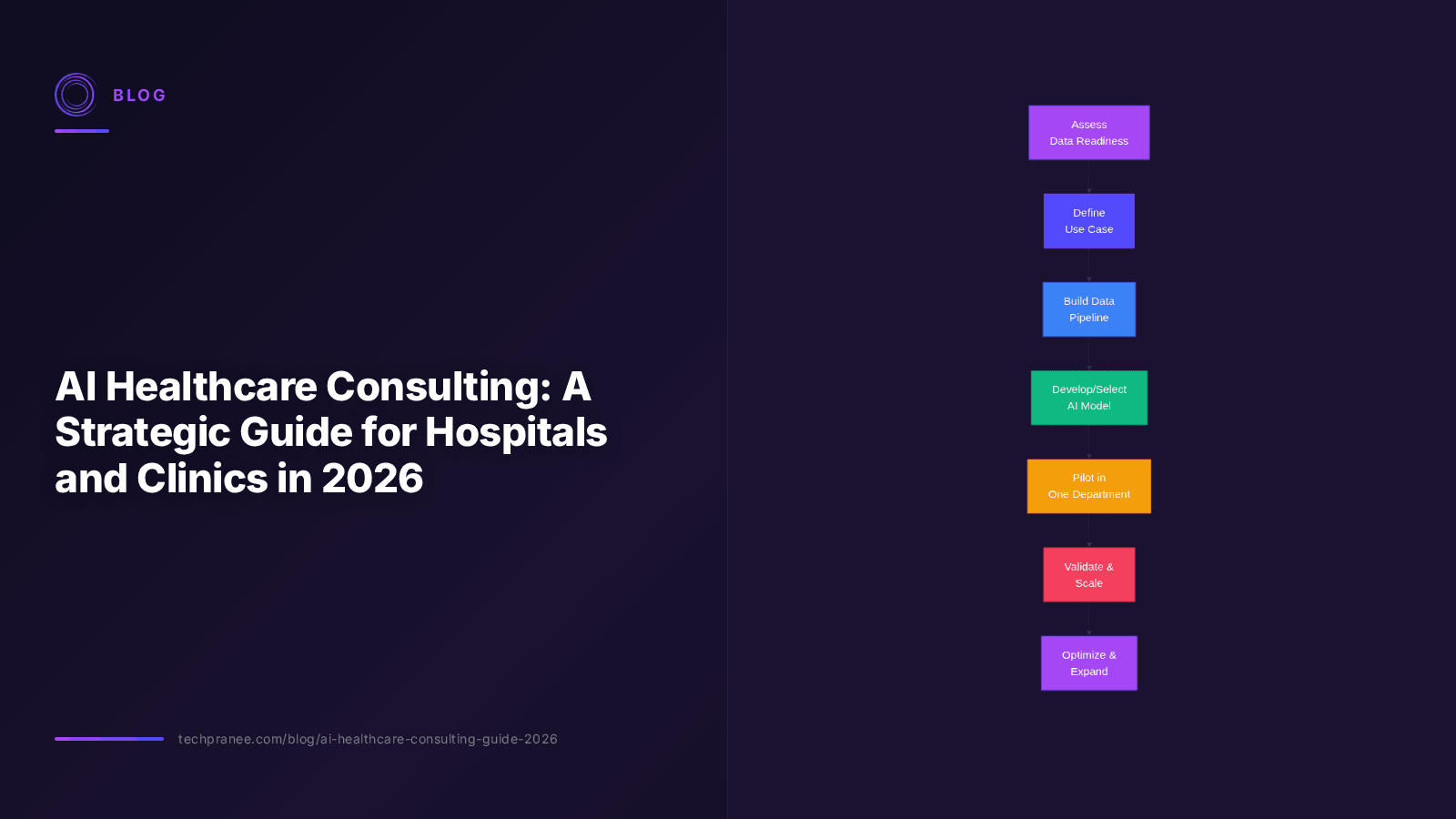
Based on successful implementations across hospitals and health systems, here's a proven seven-step process that AI healthcare consultants typically follow:
- Conduct an AI Readiness Assessment (Weeks 1-4): Evaluate your data infrastructure, EHR systems, clinical workflows, and organizational culture. Identify quick wins and long-term opportunities. This phase produces a prioritized AI roadmap with estimated ROI for each use case.
- Define the Use Case and Success Metrics (Weeks 4-6): Select one high-impact use case for the pilot. Define measurable success criteria: e.g., "reduce claim denials by 20% in 90 days" or "decrease diagnostic turnaround time by 30%." Get clinical and administrative leadership to sign off on metrics.
- Build the Data Pipeline (Weeks 6-12): Establish HIPAA-compliant data extraction from EHR, imaging systems, and administrative databases. Create a healthcare data lake or warehouse. Ensure de-identification and access controls are in place. This is often the most underestimated phase.
- Develop or Select the AI Model (Weeks 12-20): Decide between a pre-validated vendor model (faster, lower risk) or a custom model (higher customization, longer timeline). Train and validate on your data. For clinical AI, plan for FDA SaMD clearance if required.
- Pilot with a Controlled Scope (Months 5-8): Deploy in one department or unit. Monitor performance against baseline. Collect clinician feedback weekly. Adjust workflows based on real usage patterns. A successful pilot proves the model works in your specific environment.
- Validate and Scale (Months 8-12): After pilot success, expand to additional departments. Build the governance framework for ongoing model monitoring, bias detection, and performance tracking. Train new user groups. Establish the AI operations team (internal or consultant-led).
- Optimize and Expand (Ongoing): Monitor model drift, retrain as needed, and expand to new use cases. The best AI healthcare programs compound value over time as data improves, models mature, and organizational confidence grows.
Implementation Checklist
- ✓ HIPAA Business Associate Agreement (BAA) signed with consultant
- ✓ Data governance committee established with clinical representation
- ✓ EHR vendor (Epic/Cerner) integration plan approved
- ✓ Pilot department identified with willing clinical champion
- ✓ Success metrics defined and baselined before deployment
- ✓ Model validation performed on local patient population
- ✓ Clinical workflow integration designed (not bolted on)
- ✓ Change management plan with physician/nurse training scheduled
- ✓ AI model monitoring dashboard deployed
- ✓ Bias and fairness testing completed across demographic groups
- ✓ Incident response plan for AI model failures or drift
Real-World Case Studies
Case Study 1: Regional Health System — RCM AI Implementation
A 400-bed regional health system was losing $12 million annually to claim denials. An AI healthcare consulting engagement deployed an AI-powered denial prediction and prevention system integrated with their Epic EHR and billing platform. Within 6 months, denial rates dropped from 11.2% to 7.3%, recovering $4.2 million in the first year. The total consulting cost was $180,000, delivering a 23x ROI in year one alone.
Case Study 2: HyreFast — AI-Powered Clinical Staffing
HyreFast, a healthcare staffing platform, used AI consulting to build a predictive staffing model that forecasts nurse demand by department, shift, and day. The AI model reduced overstaffing costs by 22% and understaffing incidents by 31%. The engagement included model development, EHR integration, and clinician adoption training over a 7-month period.
Case Study 3: Academic Medical Center — Diagnostic AI
A major academic medical center implemented AI-assisted radiology for stroke detection. The AI reduced door-to-CT interpretation time by 40%, enabling faster intervention decisions. The consulting engagement included model selection, PACS integration, FDA compliance documentation, and radiologist training. Stroke outcomes improved measurably, with average time-to-treatment reduced by 23 minutes.
Common Pitfalls in AI Healthcare Projects (and How to Avoid Them)
Based on post-mortem analysis of failed AI healthcare initiatives, these are the most common reasons projects stall or fail:
- Poor data quality: Garbage in, garbage out. 60% of AI project failures trace back to data issues. Invest in data quality assessment before model development.
- Clinician resistance: AI that's imposed on clinicians fails. Involve clinical champions from day one and co-design workflows.
- Scope creep: Starting with "AI for everything" guarantees failure. Pick one use case, prove it, then expand.
- Neglecting model monitoring: Models degrade over time as patient populations and clinical protocols change. Build monitoring into the project from the start.
- Underestimating integration: The AI model is 20% of the work. Integration with EHR, PACS, and workflows is 80%. Budget accordingly.
- Ignoring equity: AI models can perpetuate biases in healthcare data. Test models across racial, gender, and socioeconomic groups before deployment.
AI Healthcare Consulting vs. General AI Consulting: What's Different?
Healthcare AI is not just "AI plus healthcare rules." The domain complexity requires specialized expertise that general AI consultants lack:
| Factor | General AI Consulting | AI Healthcare Consulting |
|---|---|---|
| Data Standards | SQL, NoSQL, APIs | HL7, FHIR, DICOM, ICD-10, CPT, SNOMED CT |
| Compliance | GDPR, CCPA | HIPAA, HITECH, FDA SaMD, 21 CFR Part 11, state privacy laws |
| Stakeholders | Business users, IT | Physicians, nurses, administrators, compliance officers, IT, patients |
| Model Validation | Accuracy metrics | Clinical validation, FDA clearance, bias testing across demographics |
| Integration Targets | CRM, ERP, custom apps | Epic, Cerner, Athenahealth, PACS, RIS, lab systems, billing platforms |
| Risk Profile | Business risk | Patient safety, clinical liability, regulatory penalties |
Practical Action Items: Getting Started with AI Healthcare Consulting
If you're ready to explore AI for your healthcare organization, here are concrete next steps:
- Audit your data readiness: Before engaging a consultant, assess your EHR data quality, integration capabilities, and existing data infrastructure. This determines your starting point and budget range.
- Identify your top 3 pain points: Rank operational challenges by financial impact. The best AI use case is one where the ROI is clearly measurable and the stakeholder is eager for change.
- Build a cross-functional AI committee: Include a physician, nurse, IT leader, compliance officer, and finance leader. AI in healthcare touches every department — decisions can't be made in isolation.
- Request proposals from 3-5 consultants: Use the evaluation framework above. Ask for healthcare-specific case studies, references from similar-sized organizations, and a phased implementation approach.
- Start with a strategy assessment: A $15K-$50K assessment engagement is low-risk and produces a prioritized roadmap. It also lets you evaluate the consultant's quality before committing to a larger engagement.
Frequently Asked Questions
How much does AI healthcare consulting cost?
AI healthcare consulting costs range from $15,000 for a strategy assessment to $750,000+ for enterprise-wide AI transformation. Most organizations start with a pilot project ($25K-$100K) to validate AI in their environment before scaling. Ongoing optimization typically costs $5K-$15K per month.
How long does an AI healthcare project take?
A typical pilot project runs 3-6 months from data pipeline setup to initial results. Full department-wide implementations take 6-12 months. Enterprise AI transformations spanning multiple departments require 12-24 months. The data pipeline phase is often the longest and most underestimated.
Is AI healthcare consulting only for large hospitals?
No. Mid-size clinics and specialty practices benefit from AI consulting, particularly for revenue cycle management, patient engagement, and documentation automation. Consultants can tailor engagement scope and budget to match organizational size. Many use cases (like AI-powered billing and scheduling) deliver ROI regardless of organization size.
How do I ensure my AI project is HIPAA compliant?
Your consultant should sign a Business Associate Agreement (BAA), use HIPAA-compliant data infrastructure, implement proper de-identification, and follow the minimum necessary standard for data access. For clinical AI that qualifies as Software as a Medical Device (SaMD), FDA clearance or 510(k) may be required. Your consultant should have experience navigating these regulatory pathways.
What's the difference between AI healthcare consulting and health IT consulting?
Health IT consulting focuses on infrastructure, EHR implementation, and system integration. AI healthcare consulting focuses on leveraging AI/ML to automate decisions, predict outcomes, and augment clinical capabilities. While there's overlap, AI consultants bring data science and machine learning expertise that traditional health IT consultants typically lack.
Can AI replace physicians in healthcare?
No. Current AI in healthcare is augmentative, not replacement-oriented. AI excels at pattern recognition, data processing, and repetitive tasks, freeing physicians to focus on complex clinical reasoning, patient communication, and care decisions. The most successful AI implementations enhance clinician capabilities rather than attempting to replace them.
Next Steps
AI healthcare consulting can transform how your organization delivers care, manages operations, and controls costs — but success depends on choosing the right partner and following a structured implementation approach. The organizations seeing the best results didn't start with the most ambitious projects; they started with focused, measurable pilots that proved value before scaling.
If you're ready to explore how AI can work for your healthcare organization, our team at SpearHub specializes in AI healthcare consulting — from strategy assessment to full-scale implementation. We bring clinical AI experience, regulatory expertise, and a phased methodology that minimizes risk while maximizing ROI.
For more insights on AI consulting and automation, explore our guides on AI consulting services and pricing and AI automation services for businesses. Learn more about our healthcare AI solutions and how we help providers improve outcomes with intelligent automation.