
Key Takeaways:
- AI and ML consulting combines strategic AI advisory with hands-on machine learning engineering — a single engagement that covers ideation, model development, and production deployment.
- Businesses that integrate AI and ML under one consulting partner reduce project handoff delays by up to 40% compared to hiring separate AI strategy and ML engineering vendors.
- The global AI consulting market is projected to reach $64 billion by 2028, with combined AI+ML services growing fastest as enterprises seek end-to-end delivery.
- Typical engagement models include assessment-only ($5K–$15K), proof-of-concept ($15K–$50K), and full production deployment ($50K–$200K+).
- Choosing a combined AI and ML consulting firm gives you a unified data strategy, faster time-to-value, and a single accountable partner for outcomes.
AI and ML Consulting: A Practical Guide to Combined Artificial Intelligence and Machine Learning Services
Artificial intelligence and machine learning are no longer separate disciplines — they're two halves of the same transformation engine. AI and ML consulting brings strategy and engineering together so a business can move from "we should use AI" to a deployed, measurable, revenue-generating model without juggling three vendors. If you've been searching for a partner that handles both the what should we build (AI strategy) and the how do we build it (ML engineering), this guide breaks down what combined AI and ML consulting services include, what they cost, and how to choose the right firm.
The demand for integrated AI and ML consulting has surged as enterprises realize that strategy-only engagements produce slide decks, not deployed models, while engineering-only engagements build models that solve the wrong problem. A 2025 McKinsey report found that companies using a single combined AI/ML consulting partner were 1.7x more likely to reach production deployment within 12 months than those splitting strategy and engineering across vendors. That gap matters — every month a model sits in prototype is a month of unrealized ROI.
This guide covers the full lifecycle of an AI and ML consulting engagement: what services to expect, how pricing works, how to evaluate a firm, and a step-by-step selection process you can follow this week.
What Is AI and ML Consulting?
AI and ML consulting is an integrated service offering that covers the entire AI adoption journey — from identifying high-ROI use cases to building, deploying, and maintaining machine learning models in production. Where a traditional AI consultant might hand you a strategy document and exit, a combined AI and ML consulting firm stays engaged through implementation, MLOps setup, and ongoing model monitoring.
The Two Pillars
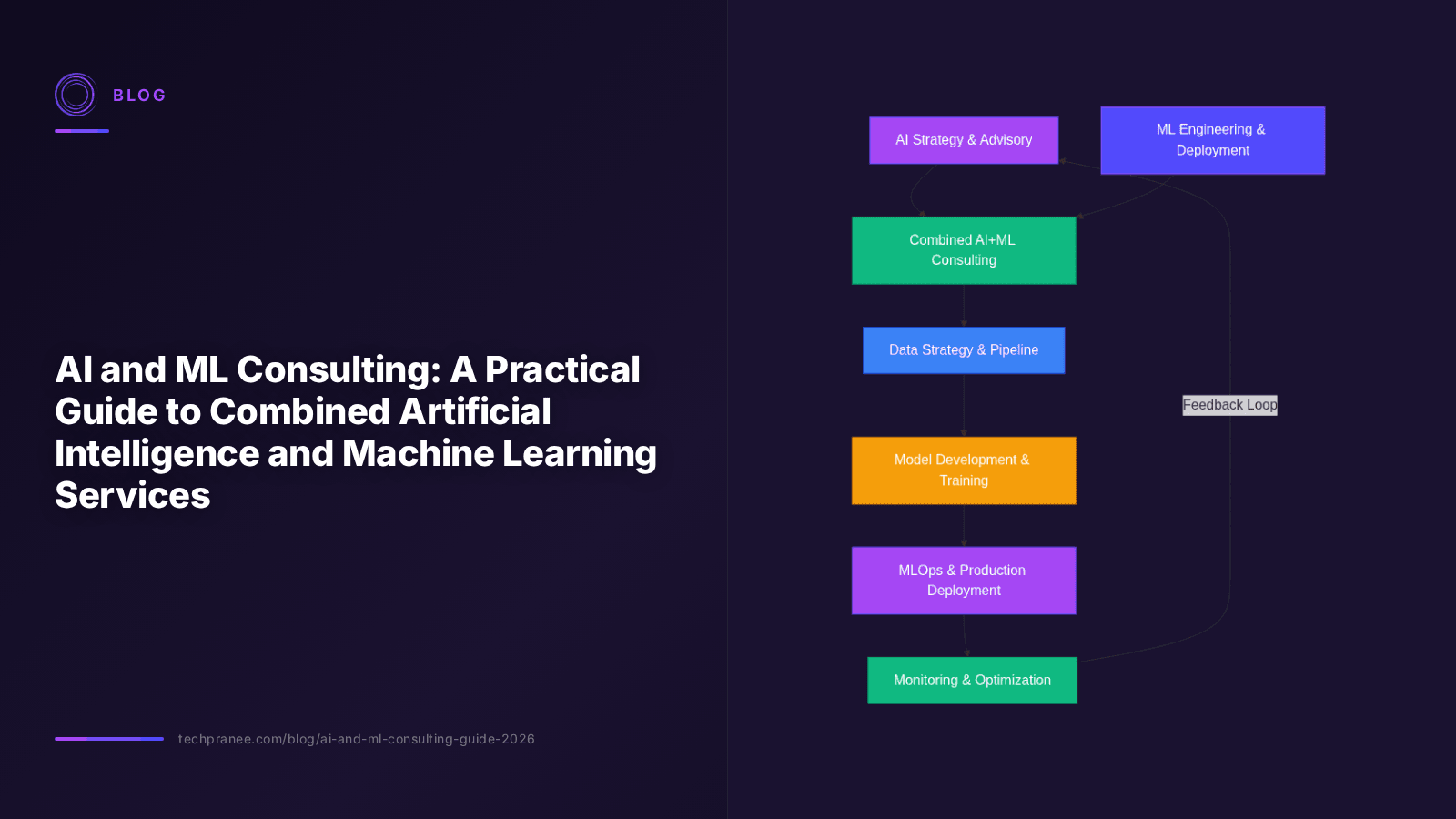
Combined AI and ML consulting rests on two connected pillars:
- AI Strategy & Advisory — Use case discovery, feasibility analysis, ROI modeling, technology selection, governance frameworks, and change management. This is the "what and why" layer.
- ML Engineering & Deployment — Data pipeline design, model development, training, evaluation, MLOps infrastructure, production deployment, and monitoring. This is the "how" layer.
The integration matters because the two pillars feed each other. Strategy informs which models are worth building; engineering reality feeds back into which strategies are feasible. When these live in separate vendors, that feedback loop breaks — and projects stall.
Why Businesses Are Choosing Combined AI and ML Consulting
The shift toward integrated AI and ML consulting isn't just a preference — it's driven by measurable outcomes. A 2025 Deloitte survey of 1,400 enterprises found that 62% of AI projects fail to reach production, and the top three causes all trace back to the strategy-engineering disconnect: unclear requirements, unrealistic scope, and data readiness gaps that surface too late.
The Cost of Fragmented Vendors
When a business hires an AI strategy firm and a separate ML engineering shop, three problems recur:
- Translation loss — The strategy firm's recommendations arrive as a 60-slide deck. The engineering firm has to reverse-engineer intent, and critical context gets lost. Average added timeline: 4–8 weeks.
- Accountability gaps — When the model underperforms, the strategy firm blames the implementation and the engineering firm blames the strategy. No one owns the outcome.
- Duplicated data work — Both vendors assess data independently, leading to redundant audits and conflicting data governance recommendations.
A combined AI and ML consulting partner eliminates these friction points. One team owns the problem from discovery to deployment, and the feedback loop between strategy and engineering stays internal.
What's Included in AI and ML Consulting Services
A comprehensive AI and ML consulting engagement typically includes five service layers. Not every engagement needs all five — but a capable firm should offer them all so you can scale up without switching partners.
1. AI Opportunity Assessment
The engagement starts with a structured discovery process: interviews with business stakeholders, a data audit, and a prioritized opportunity matrix. The output is a ranked list of AI/ML use cases with estimated ROI, technical feasibility scores, and a recommended starting point. This phase typically takes 2–4 weeks.
2. Data Strategy and Engineering
Before any model gets built, the consulting firm assesses data quality, builds pipelines, and establishes a data foundation. This includes data cleaning, feature engineering, and setting up the infrastructure (data warehouse, feature store, labeling workflows) that downstream ML models depend on. A Gartner study found that 80% of AI project time is spent on data preparation — a combined firm handles this as part of the engagement, not as a surprise add-on.
3. Model Development and Training
This is the ML engineering core: selecting algorithms, training models, running experiments, and evaluating against business metrics (not just accuracy). A strong AI and ML consulting firm will train multiple model variants, compare them on a transparent scorecard, and recommend the best fit based on your deployment constraints — latency, cost, explainability, and regulatory requirements.
4. MLOps and Production Deployment
Getting a model to 85% accuracy in a notebook is table stakes. Deploying it behind an API with monitoring, drift detection, automated retraining, and rollback capability is where most projects fail. Combined AI and ML consulting services include building the MLOps infrastructure — CI/CD for models, model registries, serving layers, and observability dashboards.
5. Ongoing Optimization and Governance
Models degrade. Data drifts. Business conditions change. A responsible consulting partner sets up monitoring, retraining schedules, and governance reviews to keep models performing. This is often a monthly retainer engagement after the initial deployment.
AI and ML Consulting Pricing: What to Expect
Pricing for combined AI and ML consulting services follows a stage-gated model. You don't commit to a $200K deployment on day one — you start with an assessment and scale based on results. Here's what the market looks like in 2026:
| Engagement Type | Duration | Cost Range | What's Included |
|---|---|---|---|
| AI Opportunity Assessment | 2–4 weeks | $5,000–$15,000 | Use case discovery, data audit, ROI prioritization, roadmap |
| Proof of Concept (PoC) | 4–8 weeks | $15,000–$50,000 | Single model prototype, baseline evaluation, deployment architecture |
| Production Deployment | 3–6 months | $50,000–$200,000+ | Full model development, MLOps setup, API deployment, monitoring |
| Ongoing Optimization | Monthly retainer | $5,000–$15,000/mo | Model monitoring, retraining, governance, performance reporting |
The assessment phase is where you should start. It's low-cost, low-risk, and gives you a concrete roadmap with ROI estimates before you commit to a larger build. Any consulting firm that wants to skip straight to a $200K deployment without an assessment is a red flag.
How to Choose an AI and ML Consulting Firm: Step-by-Step
Selecting the right combined AI and ML consulting partner is the single highest-leverage decision in your AI journey. Here's a structured process you can complete in 1–2 weeks:
- Audit your data readiness — Before talking to any firm, assess what data you have, where it lives, and its quality. A consulting firm can't give you an accurate proposal without knowing your data landscape. Document your top 3 data sources, their formats, and known quality issues.
- Define 2–3 candidate use cases — Don't go in with "we want to do AI." Bring specific problems: "We want to reduce customer churn by 15% using predictive modeling" or "We want to automate invoice processing with 95% accuracy." Specific use cases let consulting firms give you meaningful proposals.
- Shortlist 3–5 firms with both strategy and engineering capability — Look for firms that explicitly offer both AI advisory and ML engineering. Check their case studies for deployed models (not just prototypes), and verify they have MLOps experience. If a firm only talks about strategy and can't show production deployments, they're not a combined partner.
- Request a paid assessment — The best firms offer (or accept) a paid 2–4 week assessment. This is your due diligence: you see their methodology, their team, and their communication style before committing to a larger engagement. Budget $5K–$15K for this.
- Evaluate the assessment output — The deliverable should include a prioritized use case matrix, a data readiness score, a recommended architecture, and a fixed-scope proposal for the next phase. If the assessment output is vague or slides-only, walk away.
- Start with a proof of concept — Commit to a 4–8 week PoC for the top-priority use case. This is where the firm proves they can deliver. Set clear success criteria upfront — target accuracy, latency requirements, and a go/no-go decision date.
- Scale to production with stage gates — If the PoC hits its success criteria, move to a production deployment engagement. Use stage gates: don't approve the next phase until the previous one meets its criteria. This keeps you in control of budget and scope.
Checklist: What to Look for in an AI and ML Consulting Firm
- ✓ Case studies showing deployed models in production (not just prototypes)
- ✓ In-house team covering both AI strategy and ML engineering
- ✓ MLOps capability (CI/CD for models, monitoring, drift detection)
- ✓ Experience in your industry or a similar regulatory environment
- ✓ Transparent pricing with stage-gated engagement model
- ✓ Willingness to start with a paid assessment before large commitments
- ✓ Clear IP and data ownership terms (you own the models and code)
- ✓ Post-deployment support and model monitoring services
Real-World Example: Zovia's Combined AI and ML Approach
Consider Zovia, an AI-powered sales intelligence platform. When Zovia needed to build a lead-scoring model, they didn't split the work between a strategy consultant and an ML engineering shop. They used a combined AI and ML consulting approach: the same team that identified the lead-scoring opportunity also built the data pipeline, trained the ranking model, and deployed it behind their existing CRM integration. The result was a production model live in 10 weeks — a timeline that would have stretched to 6+ months with fragmented vendors, based on industry benchmarks.
The most expensive part of an AI project isn't the model — it's the gap between strategy and execution. A combined AI and ML consulting partner closes that gap by keeping the people who defined the problem in the room when the model gets built.
AI and ML Consulting vs. Separate AI Strategy and ML Engineering
If you're weighing combined consulting against hiring separate specialists, here's a direct comparison:
| Factor | Combined AI and ML Consulting | Separate AI Strategy + ML Engineering |
|---|---|---|
| Time to production | 3–6 months (single team, no handoff) | 6–12 months (handoff delays, re-scoping) |
| Accountability | Single partner owns outcome end-to-end | Split — each vendor can blame the other |
| Data work | One data audit, one pipeline, one governance framework | Duplicated audits, potential conflicts |
| Cost efficiency | Lower total cost (no rework, no translation loss) | Higher total cost (rework, extended timelines) |
| Flexibility | Strategy and engineering adjust together as reality changes | Change requests trigger contract renegotiation between vendors |
| Best for | Companies that want speed and single-vendor accountability | Companies with in-house PMO capable of coordinating vendors |
For most mid-market and enterprise businesses without a dedicated AI program management office, combined consulting is the faster, lower-risk path.
Technical Foundation: What a Combined Engagement Builds
For technical leaders evaluating AI and ML consulting services, here's what the infrastructure deliverables look like in a production engagement. A capable firm should be able to discuss each of these in concrete terms:
# Typical MLOps stack from a combined AI+ML consulting engagement
# Data layer
data_warehouse: Snowflake / BigQuery
feature_store: Feast / Tecton
data_pipeline: Airflow / dbt

# Model layer
experiment_tracking: MLflow / Weights & Biases
model_registry: MLflow Model Registry
serving: FastAPI + Ray Serve / Seldon Core

# Monitoring layer
drift_detection: Evidently / Alibi Detect
observability: Grafana + Prometheus
alerting: PagerDuty integration

# CI/CD
model_pipeline: GitHub Actions / GitLab CI
deployment: Kubernetes / AWS SageMaker
If a consulting firm can't articulate this stack — or insists on a proprietary black-box platform — that's a signal they're more interested in lock-in than in building your internal capability. The best AI and ML consulting firms build infrastructure you own and can maintain.
Common Pitfalls in AI and ML Consulting Engagements
- Starting with the model, not the problem — Firms that lead with "we'll build you a neural network" before understanding your business problem are solving for their toolkit, not your outcomes.
- Ignoring data quality — 80% of ML project effort is data work. If a firm glosses over data assessment in their proposal, expect scope creep and delays later.
- No MLOps plan — A model without monitoring, drift detection, and retraining is a ticking time bomb. Production deployment must include MLOps from day one.
- Proprietary platform lock-in — If the firm builds your model on a platform you can't access or maintain without them, you don't own your AI capability. You're renting it.
- No success criteria — Every phase should have measurable success criteria agreed upfront. Without them, "done" becomes subjective and engagements drag on.
Practical Action Items: Getting Started This Week
- Document your top 3 data sources — What systems hold your richest data (CRM, ERP, product analytics, support tickets)? Note their formats, volumes, and known quality issues. This is the foundation any consulting firm needs.
- Write 2–3 specific use case hypotheses — Frame them as problems with measurable outcomes: "Reduce inventory carrying cost by 10% using demand forecasting" beats "explore AI for supply chain."
- Shortlist 3 combined AI and ML consulting firms — Look for production case studies, MLOps capability, and experience in your industry. Request paid assessments from your top 2.
- Set a budget for the assessment phase — $5K–$15K for a 2–4 week assessment is standard. This is your lowest-risk entry point and gives you a concrete roadmap before committing more.
- Define your success criteria before the PoC — Target accuracy, latency, business metric improvement, and a go/no-go date. Write these down and share them with your consulting partner before the PoC starts.
Frequently Asked Questions
What's the difference between AI consulting and ML consulting?
AI consulting focuses on strategy — identifying use cases, selecting technologies, and building governance frameworks. ML consulting focuses on engineering — building, training, and deploying machine learning models. Combined AI and ML consulting covers both under one engagement, eliminating the handoff gap that causes most AI projects to stall.
How much does AI and ML consulting cost?
A typical engagement starts with a $5K–$15K assessment (2–4 weeks), progresses to a $15K–$50K proof of concept (4–8 weeks), and scales to $50K–$200K+ for full production deployment (3–6 months). Ongoing optimization is usually a $5K–$15K/month retainer. You should never commit to the full amount upfront — use stage gates to control spend.
How long does an AI and ML consulting engagement take?
From assessment to production deployment, expect 4–8 months for a first AI initiative. The assessment takes 2–4 weeks, a PoC takes 4–8 weeks, and production deployment takes 3–6 months. Firms that promise production models in "a few weeks" are either oversimplifying or delivering a prototype, not a production system.
Should I hire a combined AI and ML consulting firm or build an in-house team?
For your first 1–2 AI initiatives, a combined consulting firm is faster and lower-risk than building an in-house team (which takes 6–12 months to hire and ramp). The best consulting firms also transfer knowledge and build infrastructure your team can maintain, so you build internal capability while getting immediate results. See our comparison of AI automation agency vs. in-house AI team for a deeper analysis.
What industries benefit most from combined AI and ML consulting?
Any data-rich industry benefits — manufacturing (predictive maintenance, quality inspection), healthcare (diagnostic assistance, patient routing), financial services (fraud detection, credit scoring), retail (demand forecasting, personalization), and logistics (route optimization, inventory management). The key prerequisite is having enough historical data to train models effectively.
How do I know if my data is ready for AI and ML consulting?
You need three things: sufficient volume (typically 10,000+ records for supervised learning), reasonable quality (identifiable schemas, known missing-data patterns), and accessibility (available via API, database, or export). A good consulting firm will assess this in the first 2 weeks and tell you honestly if you're ready or what gaps to close first.
Conclusion
AI and ML consulting is the fastest path from AI ambition to deployed, measurable outcomes — because it keeps strategy and engineering under one roof. The firms that do this well don't just build models; they build the data foundation, the MLOps infrastructure, and the governance framework that makes AI a durable capability in your business rather than a one-off science project.
If you're ready to explore what combined AI and ML consulting could look like for your business, start with a conversation. We'll help you assess your data readiness, identify your highest-ROI use cases, and build a roadmap that takes you from assessment to production — with one accountable partner the entire way.
Looking for broader AI strategy guidance? See our complete AI consulting services guide or explore our AI strategy consulting services.